‘We got a deep, Jewish brother named Bernie Sanders who’s bringing us together.’ — Cornel West electrified a stadium of Bernie supporters with this passionate rallying speech pic.twitter.com/AlD7n1VzEp— NowThis (@nowthisnews) February 17, 2020
Monday, February 17, 2020
Brother Cornel can preach!

John Kaag on happiness and healthy minds
From the celebrated author of American Philosophy: A Love Story and Hiking with Nietzsche, a compelling introduction to the life-affirming philosophy of William James
In 1895, William James, the father of American philosophy, delivered a lecture entitled "Is Life Worth Living?" It was no theoretical question for James, who had contemplated suicide during an existential crisis as a young man a quarter century earlier. Indeed, as John Kaag writes, "James's entire philosophy, from beginning to end, was geared to save a life, his life"―and that's why it just might be able to save yours, too. Sick Souls, Healthy Minds is a compelling introduction to James's life and thought that shows why the founder of pragmatism and empirical psychology―and an inspiration for Alcoholics Anonymous―can still speak so directly and profoundly to anyone struggling to make a life worth living.
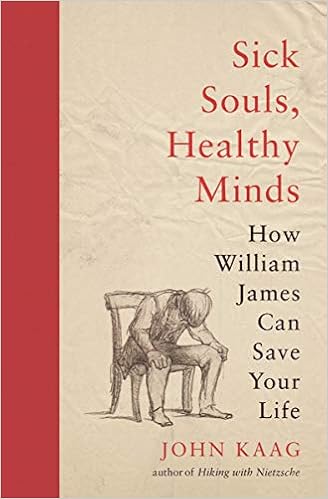 Kaag tells how James's experiences as one of what he called the "sick-souled," those who think that life might be meaningless, drove him to articulate an ideal of "healthy-mindedness"―an attitude toward life that is open, active, and hopeful, but also realistic about its risks. In fact, all of James's pragmatism, resting on the idea that truth should be judged by its practical consequences for our lives, is a response to, and possible antidote for, crises of meaning that threaten to undo many of us at one time or another. Along the way, Kaag also movingly describes how his own life has been endlessly enriched by James.
Eloquent, inspiring, and filled with insight, Sick Souls, Healthy Minds may be the smartest and most important self-help book you'll ever read.
==
The only thing in your control is your thoughts and feelings. Dedicate life to these not outcomes, which are outside your control. @DerrenBrown @JohnKaag #lifelessonsfestival pic.twitter.com/H7b1A2EHKS— Amy Lowe (@FirstPositionLC) February 16, 2020
Sunday, February 16, 2020
IF GOD IS DEAD, YOUR TIME IS EVERYTHING
[Looking ahead to our next read...]
Martin Hägglund argues that rigorous secularism leads to socialism [which seems to appeal to many younger potential voters...]
At a recent conference on belief and unbelief hosted by the journal Salmagundi, the novelist and essayist Marilynne Robinson confessed to knowing some good people who are atheists, but lamented that she has yet to hear “the good Atheist position articulated.” She explained, “I cannot engage with an atheism that does not express itself.”
She who hath ears to hear, let her hear. One of the most beautifully succinct expressions of secular faith in our bounded life on earth was provided not long after Christ supposedly conquered death, by Pliny the Elder, who called down “a plague on this mad idea that life is renewed by death!” Pliny argued that belief in an afterlife removes “Nature’s particular boon,” the great blessing of death, and merely makes dying more anguished by adding anxiety about the future to the familiar grief of departure. How much easier, he continues, “for each person to trust in himself,” and for us to assume that death will offer exactly the same “freedom from care” that we experienced before we were born: oblivion.
No doubt much will depend on our definitions of “atheist” and “good.” But, if Pliny is too antique for Robinson, listen to Montaigne: the Montaigne who professed a nominal Christianity but proceeded as if his formal belief were essentially irrelevant to his daily existence, and perhaps even at odds with it; the Montaigne whose wanton pagan invocation of “fortune” in his essays provoked Vatican censors. Or attend to the work and life of Chekhov, the good nonbelieving doctor who asserted that his “holy of holies” was the human body, the writer whose adulterous characters in “The Lady with the Little Dog” stop to look at the sea near Yalta and are reminded that their small drama is nothing alongside the water’s timeless indifference:
And in this constancy, in this complete indifference to the life and death of each of us, there lies hid, perhaps, a pledge of our eternal salvation, of the unceasing movement of life upon earth, of unceasing progress towards perfection. Sitting beside a young woman who in the dawn seemed so lovely, soothed and spellbound in these magical surroundings—the sea, mountains, clouds, the open sky—Gurov thought how in reality everything is beautiful in this world when one reflects: everything except what we think or do ourselves when we forget our human dignity and the higher aims of our existence.
Or James Baldwin, that great recovering Christian, who once wrote, “I have always felt that a human being could only be saved by another human being.” Or Primo Levi, who, when faced with death in Auschwitz, was briefly tempted to pray for rescue, and then did not pray, lest he blaspheme his own secularity. Or Camus, especially in “The Myth of Sisyphus” (a philosophical articulation of the atheistic world view), and in his rapturous unfinished novel, “The First Man” (a novelistic embodiment of the secular world view), in which his alter ego is possessed, from childhood, of “a love of bodies” that exalted him when he was able “just to enter into their radiance, to lean his shoulder against his friend’s with a great sensation of confidence and letting go, and almost to faint when a woman’s hand lingered a moment on his in the crowd of the trolley—the longing, yes, to live, to live still more, to immerse himself in the greatest warmth this earth could give him.”
Or Louise Glück’s extraordinary poem “Field Flowers,” narrated from the perspective of a flower, which chides its human visitors for thinking about eternal life instead of looking more closely at the flowers. In that poem, humans become spectral, and the natural world has the real, everlasting solidity:
. . . Your poor
idea of heaven: absence
of change. Better than earth? How
would you know, who are neither
here nor there, standing in our midst?
Finally, Robinson could look at her own first novel, “Housekeeping,” which is essentially about people in rural Idaho constructing a usable creed out of the near at hand: scraps of the Bible, bits and pieces of culture and folklore, fantasies of resurrection, and a great deal of the natural world, thrillingly described. In that book, Robinson’s lovely phrase “the resurrection of the ordinary” means springtime, which unfailingly occurs every year, not the resurrection of human beings, which seems much more doubtful.
These are visions of the secular. A systematic articulation of the atheistic world view, the one Marilynne Robinson may have been waiting for, is provided by an important new book, Martin Hägglund’s “This Life: Secular Faith and Spiritual Freedom” (Pantheon). Hägglund doesn’t mention any of the writers I quoted, because he is working philosophically, from general principles. But his book can be seen as a long footnote to Pliny, and shares the Roman historian’s humane emphasis: we need death, as a blessing; eternity is at best incoherent or meaningless, and at worst terrifying; and we should trust in ourselves rather than put our faith in some kind of transcendent rescue from the joy and pain of life. Hägglund’s book involves deep and demanding readings of St. Augustine, Kierkegaard, Marx, and Martin Luther King, Jr. (with some Theodor Adorno, Charles Taylor, Thomas Piketty, and Naomi Klein thrown in), but it is always lucid, and is at its heart remarkably simple. You could extract its essence and offer it to thirsty young atheists.
His argument is that religious traditions subordinate the finite (the knowledge that life will end) to the eternal (the “sure and certain hope,” to borrow a phrase from the Anglican Book of Common Prayer, that we will be released from pain and suffering and mortality into the peace of everlasting life). A characteristic formulation, from St. Paul’s Epistle to the Colossians, goes as follows: “Set your minds on things that are above, not on things that are on earth, for you have died, and your life is hidden with Christ in God.” You die into Christ and thus into eternity, and life is just the antechamber to an everlasting realm that is far more wondrous than anything on earth. Hägglund, by contrast, wants us to fix our ideals and attention on this life, and more of it—Camus’s “longing, yes, to live, to live still more.” Hägglund calls this “living on,” as opposed to living forever... (James Wood, continues)
Mr. Deity
==
Richard Dawkins Puts Foot in Mouth Again With Tweets About How Eugenics “Works”
Death and Secular Meaning
By: Heather Faulkner
 I grew up in the Mormon church, but it wasn't until my teen years that I would begin to question the religion I was born into. After personal introspection, research, and a lot of back and forth, I eventually identified myself as an agnostic (until I accepted that I was really an atheist).
The scariest part about losing my faith wasn't that I was leaving behind the weekly communal gatherings or even the structure and guidelines provided by my church. What scared me the most was that I no longer had eternal life in heaven to look forward to with God and my loved ones. At times I felt regret for letting my curiosity, "lead me astray," because although secularism made sense to me intellectually, suddenly life didn't seem as special, important, or meaningful anymore. Over the years, however, I have managed to find peace, comfort, and meaning again in my secular worldview.
My report will examine secular perspectives, in comparison with religious perspectives, on the nature of death, and what kind of impact these different views have on the meaning of one's life. For further discussion, I will introduce concepts and ideas from Christopher Hitchens' memoir, Mortality. Hitchens, a prominent atheist, wrote this book during his struggle with esophageal cancer, the disease that eventually took his life.
I am looking forward to sharing these ideas with everyone on Tuesday, and I hope that we can have some thought provoking conversations on the topic in class. Below are my discussion and quiz questions.
Discussion Questions:
1. What do you think happens when people die? How does/doesn't this impact the meaning of your life?
2. Do you think that your life is intrinsically special/significant?
3. Are you afraid of death? Why/why not?
Quiz Questions:
1. In response to his seemingly unfair and untimely cancer diagnosis, Christopher Hitchens says, “To the dumb question ‘Why me?’ the cosmos barely bothers to return the reply: ‘_______?’”
“Why Not?"
2. In his memoir, Mortality, Christopher Hitchens says, “…I don't have a body, ________.”
“I am a body."
3. Who came up with what Hitchens calls, “the notorious stage theory”?
Elisabeth Kübler-Ross
Thursday, February 13, 2020
Quizzes Feb18, 20
T 18 - MP 9-10 (scroll down for *Th 20)
LISTEN
1. What's the First Principle of Existentialism?146
2. What are "distal intentions"? `149
3. What is the "causal exclusion problem"? 153
4. What does Neurofeedback demonstrate? 155
5. What makes actions meaningful? 159
6. Why, according to Jaegwon Kim, can't information be causal? 162
7. A given event, says Peter Tse, cannot be what at the same time? 166
8. What accounts of free will have given libertarianism a bad name? 171
9. What class of causation does Tse say led to biological systems and ultimately to the emergence of mind? 176
10. What allows us to make and execute choices, invent new things, reinvent ourselves, and "change the physical universe forever"? 189
DQ
*Th 20 - MP 11-12
LISTEN
1. Pereboom's and Caruso's primary focus is on what? 193
2. What are some scientific threats to free will not posed by neuroscience? 197
3. FWS allegedly leaves what intact? 203
4. The core idea of fws is what? 207
5. We may in the near future be able to determine what? 215
6. Why are we responsible for our actions, according to Michael Gazzaniga? 223
7. What's Dennett's definition of free choice? 226
8. What becomes moot from the vantage point of a layered interacting system? 230
9. Because the brain is a _____ system, thought is not a delay after action. 231
10. Gazzaniga says personal responsibility is real but not in ____. 233
DQ
LISTEN
1. What's the First Principle of Existentialism?146
2. What are "distal intentions"? `149
3. What is the "causal exclusion problem"? 153
4. What does Neurofeedback demonstrate? 155
5. What makes actions meaningful? 159
6. Why, according to Jaegwon Kim, can't information be causal? 162
7. A given event, says Peter Tse, cannot be what at the same time? 166
8. What accounts of free will have given libertarianism a bad name? 171
9. What class of causation does Tse say led to biological systems and ultimately to the emergence of mind? 176
10. What allows us to make and execute choices, invent new things, reinvent ourselves, and "change the physical universe forever"? 189
DQ
- Is meaning in your life really entirely the product of individual choice?
- Does existence really precede essence? (Or, do stable and inherited species attributes as well as environmental influences constrain our choices and possibilities?)
- If mental states were shown conclusively not to cause changes in physical states of the brain, would that then disprove free will and show that mental states are mere epiphenomena?
- Does "bidirectionality" dispel your concern that your thoughts and actions are not really your own? 148
- What do you think Libet-type experiments show?
- If you're as free as a dog leashed to a cart, are you free enough? (See SoL video below)
- Is it possible even in principle to know that micro-level particle phenomena are sufficient to determine events at the macro-level of everyday experience?
- Do you agree that only second-order or meta-free will is sufficient to make us responsible for our actions?
- add yours please
*Th 20 - MP 11-12
LISTEN
1. Pereboom's and Caruso's primary focus is on what? 193
2. What are some scientific threats to free will not posed by neuroscience? 197
3. FWS allegedly leaves what intact? 203
4. The core idea of fws is what? 207
5. We may in the near future be able to determine what? 215
6. Why are we responsible for our actions, according to Michael Gazzaniga? 223
7. What's Dennett's definition of free choice? 226
8. What becomes moot from the vantage point of a layered interacting system? 230
9. Because the brain is a _____ system, thought is not a delay after action. 231
10. Gazzaniga says personal responsibility is real but not in ____. 233
DQ
- The authors say free will skepticism does not threaten our prospects of finding meaning in life. But what if you've constructed your life on the premise that without free will we're just automata? Can you stage a meaningful 2d act, after being persuaded to accept fws? Wouldn't you have to experience the decision to do so as a free choice?
- Does the question "Why did you decide to do that?" not beg the question, for the fw skeptic? 194
- Does quantum mechanics invalidate hard determinism and incompatibilism? 198
- Do you agree with Strawson? 201
- Does the idea of preventative detention strike you as potentially beneficial, Orwellian, or somewhere in-between? 215
- Are you "uptight about our cool machine"? 223
- Does it beg the question to say that being "self-aware narrators" secures our freedom (or at least our responsibility)?
- Do you share the "strong belief among philosophers" that free will and responsibility go together inseparably? 225
- "It is because we have a contract with our social milieu that we are responsible for our actions." 233 Shouldn't Gazzaniga say that that's why we hold ourselves responsible, whether or not we are actually capable of being responsible?
Can there be freedom and free will in a deterministic world? Renowned philosopher and public intellectual, Dr. Dennett, drawing on evolutionary biology, cognitive neuroscience, economics and philosophy, demonstrates that free will exists in a deterministic world for humans only, and that this gives us morality, meaning, and moral culpability. Weaving a richly detailed narrative, Dennett explains in a series of strikingly original arguments that far from being an enemy of traditional explorations of freedom, morality, and meaning, the evolutionary perspective can be an indispensable ally. In Freedom Evolves, Dennett seeks to place ethics on the foundation it deserves: a realistic, naturalistic, potentially unified vision of our place in nature.
The first in a series of Gifford Lectures by Professor Michael Gazzaniga. Recorded 12 October, 2009 at the Playfair Library Hall, the University of Edinburgh. What do we need to know about the human brain in order to discuss the weighty questions of free will, mental causation, morals, ethics, and the law? To understand anything from a biologic perspective we must place this effort in an evolutionary context, consider the nature of the organ that allows us to be asking these questions, and to the extent that we are able, determine how it works. The fundamental point that emerges out of this analysis is that much complexity is built into the brain and not just passed along as accumulated cultural behavior and knowledge from one generation to the next. It is this built-in complexity that enables us to discover the keys to how, ultimately, the mind constrains the brain and not the other way around. We will appreciate that our automatic brains are structured complex systems with particular skill sets and that ultimately our I story—the story of our own personal, phenomenal consciousness—is embodied in the brains network systems and not in outside forces compelling the brain into action.
Hitchens on the cost of immortality
Anticipating Heather's report...
"A life that partakes even a little of friendship, love, irony, humor, parenthood, literature, and music, and the chance to take part in battles for the liberation of others cannot be called 'meaningless' except if the person living it is also an existentialist and elects to call it so. It could be that all existence is a pointless joke, but it is not in fact possible to live one's everyday life as if this were so." Christopher Hitchens
Time is Still a Mystery to ‘Einstein’s Dreams’ Author
“Einstein’s Dreams,” now translated into 30 languages, has become a pop-science landmark. The book was at the bedside of the writer Christopher Hitchens when he died 2012. He quoted from it at the end of his final book — “Mortality,” a memoir — in a chapter describing a version of time in which n.obody dies. As a result, the generations pile up, carping, criticizing and advising, and no one ever comes into their own. “Such is the cost of immortality,” Mr. Hitchens wrote. “No person is whole. No person is free.” nyt
“Einstein’s Dreams,” now translated into 30 languages, has become a pop-science landmark. The book was at the bedside of the writer Christopher Hitchens when he died 2012. He quoted from it at the end of his final book — “Mortality,” a memoir — in a chapter describing a version of time in which n.obody dies. As a result, the generations pile up, carping, criticizing and advising, and no one ever comes into their own. “Such is the cost of immortality,” Mr. Hitchens wrote. “No person is whole. No person is free.” nyt
(Alan Lightman is a physicist-cum-humanist literateur, and a native Tennessean.)
==
Hitch on meaning"A life that partakes even a little of friendship, love, irony, humor, parenthood, literature, and music, and the chance to take part in battles for the liberation of others cannot be called 'meaningless' except if the person living it is also an existentialist and elects to call it so. It could be that all existence is a pointless joke, but it is not in fact possible to live one's everyday life as if this were so." Christopher Hitchens
Subscribe to:
Posts (Atom)