Up@dawn 2.0

Sunday, February 9, 2020

Quizzes Feb 11, 13

Scroll down for *Th 13

T 11 - MP 5-6
LISTEN

1. What's the most important function of emotion? 71

2. We're built to be what? 73

3. A rational syntactically based reasoning system enables us to do what? 79

4. What is "sedimentation"? 87

5. Simone de Beauvoir's title The Ethics of Ambiguity refers to what fact? 92

6. What gets sedimented in the brain? (99)

7. For Sartre the greatest threat to human flourishing is _____, for Marx it's ____. (103)


Discussion Questions (add yours)

  • How do you think your goals as an individual relate to our shared species' interests (in survival, among other things)? How do you think all kinds of goals and interests relate to the subjective experience of meaning and purpose, and the objective possibility of their attainment?
  • Is the selfish gene hypothesis relevant to how you think about meaning and purpose in your own life, and in the existence of humanity? Are genes really selfish? 
  • How important is it, for our individual flourishing and collective well-being, that we defer gene-specified rewards in favor of long-term outcomes?
  • In the absence of a strong commitment to the social contract that binds individuals to shared norms and practices that secure their survival and dignity, would individual meaning and purpose be possible or worth pursuing?
  • Are religious people any more or less prone to self-deception ("oblivious to the genealogies of their values") than secularists?
  • Are you more sympathetic to Sartre or Merleau-Ponty on freedom?
  • If you are a Nietzschean with respect to free will, thinking it an illusion, what practical use can you make of his eternal recurrence idea?
  • Does Frantz Fannon's experience still strike you as relevant to race in America in our day?93
  • Was Hannah Arendt wrong to describe evil as banal?
  • Do you agree that Camus's view of Sisyphus is problematic? 102
  • What's the best way to free yourself from a sedimented value?


Image result for valentine chocolates
*Th 13 - MP 7-8 (Since it's practically V-day/b'day, collect a base if you bring something to sweeten our dispositions.)
LISTEN

1. ____ may not exist, but we can still impose a degree of unity on ____. 111

2. Today almost all educated people accept the reality of what? 114

3. Does Levy consider the self a user illusion? 122

4. What are the 4Ms and 4Es? 126

5. How does Heidegger say we come to a true sense of ourselves? 133

6. In light of the 4Es, authenticity is not facing  up to nothingness but rather to what? 141


Heideggerian "authenticity" here sounds a lot like parochial nationalism. 


Discussion Questions (add yours)

  • If no "unified self" exists, what do you think it might mean to unify "ourselves"?
  • Is our existence "unjustifiable" in the absence of an objective, eternal, universal source of   purpose? To whom are we required to justify our existence?
  • Do you think of yourself as "an uncaused cause" and a "foundation of all values"? Wouldn't that be a bit presumptuous and self-important>
  • Is meaning something to "impose" on your life, or something that emerges organically from it?
  • Can you accept the reality of "unconscious processes and states" but still question the reality of the Freudian Unconscious?
  • Does the "modular"/evolutionary theory of consciousness seem plausible to you? Does it imply design without a designer? Choice without a chooser?
  • What important insights into consciousness can we glean from Capgras Syndrome? 116 (There's a terrific novel by Richard Powers all about this condition called The Echo Maker, btw - possible report topic, if you're interested)
  • Do you experience existential anxiety due either to "absolute freedom" or the fact of embodiment?
  • What does it mean to you to live "authentically"?
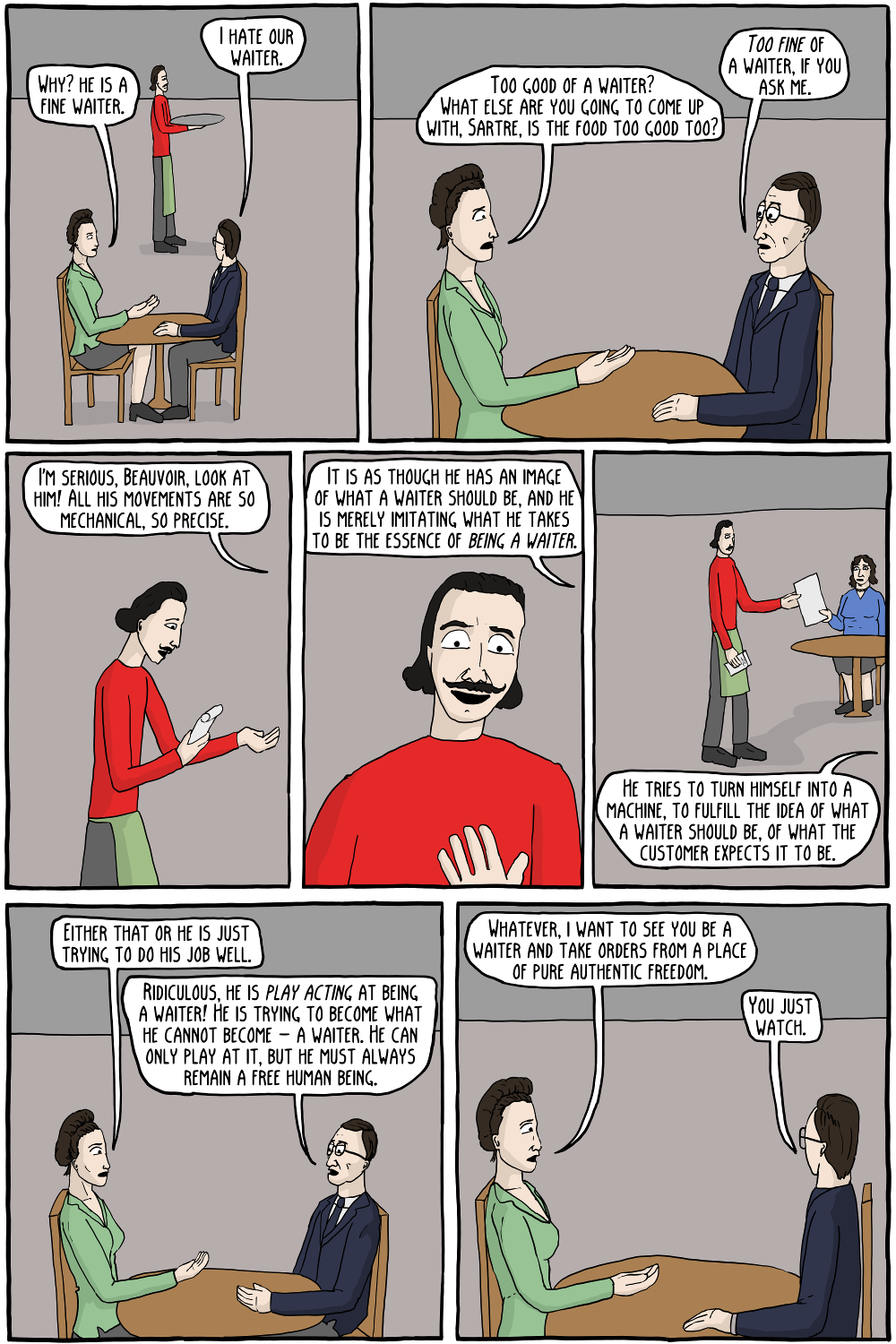
  • Is Sartre's waiter really so inauthentic? .Or is it mutually understood by waiter and customer that role-playing is an inescapable element of normal human life?


You can make a difference

Hope so. What would it be better for you to believe?

Saturday, February 8, 2020

Free the rabbit


The Blackstone Sermon

Sir William Blackstone (1723 – 1780) was an English jurist, whose Commentaries on the Laws of England (1765–69), are the best-known description of the doctrines of English law. The legal systems in the United States and Australia are based on the common law tradition, and Blackstone’s Commentaries are the bedrock upon which rests our understanding of common law.

In the first Commentary on the Nature of the Laws of England he provides an outstanding explanation of classical natural law, which is the basis for MLK’s writing from the Birmingham Jail that “there are two types of laws: there are just laws, and there are unjust laws. I would agree with St. Augustine that ‘an unjust law is no law at all.’” https://www.africa.upenn.edu/Articles_Gen/Letter_Birmingham.html

In the early 5th century B.C. E. the Greek playwright Sophocles raised a question in his play Antigone that would be forever a subject of legal philosophy – what is the relationship between law and morality; where is a person’s obligation when human law and God’s law conflict. In the play, the king orders that the body of Antigone’s brother – who had committed treason against the king – remain unburied. Antigone ignores the king’s command and buries her brother, risking her own death, saying that even the king “could not override the unwritten and unfailing law given to us by the gods.” Human law is subject to God’s law. A person is obligated to obey God’s law where it conflicts with human law.

Aristotle said that humans were political animals who organized themselves into communities, and that law is a sort of order that provides the framework for the rules and institutions through which society is constituted. He also articulated a concept which came to be seen as the ideal of the rule of law. He said that “law has a share in eternal, divine wisdom;” that “he who asks law to rule is asking God and intelligence to rule, and no others ….” Law was the means to restrain the power of tyrants who would pursue their own interests and not what was best for the community. (Consider the Trump impeachment articles, and the rule of law discussions going on today.)

The Romans had a more developed legal system than ancient Greece. The Roman jurist and philosopher Cicero (106 – 43 B.C.E.) gave us more structure, and perhaps the name “natural law,” to this theory about law. As a lawyer, he worked with the positive (human-written) law of Rome. His goal was to show the relationship between positive law and what he called “objective moral truths.” (Think Aristotle, eternal divine wisdom.) He wrote that “true law is right reason in agreement with nature,” and called the objective moral truths “laws.” To rephrase it, objective moral truths exist in nature, which we will call natural laws, and for a human law to be true law, it must conform to those natural laws. Cicero said that “those who formulated wicked and unjust statutes for nations, thereby breaking their promises and agreements, put into effect anything but ‘laws.’” I.e., there are moral criteria for determining the validity of laws. This idea took root, and 400 or so years later, Saint Augustine wrote the famous words that have become the slogan for classical natural law, that “an unjust law does not seem to be a law at all.”

The most famous treatment of classical natural law theory was Thomas Aquinas in the 13th century. Aquinas said that law has a distinctive purpose, which is to serve the common good of the political community; a way for society to realize goods which it cannot otherwise achieve (echoing Aristotle). Valid law is derived from objective moral principles (Cicero). The first way law is derived is by deduction from moral principles; a direct connection between a moral rule and a legal rule (e.g., murder). The second way law is derived is through making a determination of how a general moral principle will apply in a specific circumstance to facilitate human coordination. Traffic rules are derived from moral principles that prevent us from causing harm to others. Now Aquinas brings it home: if a law is not derived from moral principles in one of these two ways, it fails to be law. It is unjust, and an unjust law is no law at all. As a result, there is no obligation to obey the law. (Tell that to the judge and see how that works for you.)

So classical natural law claims that the content of law must be derived from objective moral principles that man can discover through reason in order to be valid and have the force of law. Classical natural law theorists believe (1) that there is a specific system of morality found in nature – a moral order; (2) this moral order is discoverable by reason; and (3) laws must conform to this moral order if they are to have the status of law.

But they claim more than just a connection between valid law and the moral order – they make a claim about the nature of the moral order. They posit a teleological view of nature. This is the idea that everything in nature, including man, is moving toward a telos; i.e., a specific end. The telos of an acorn is a full-fledged oak tree; the telos of man is biological maturity with excellent mind and character. Natural law must promote the achievement of this telos. Thus, classical natural law can be summarized as follows: (1) moral validity, being consistent with the moral order, is necessary for legal validity; and, (2) the moral order is part of the natural order; moral duties are fixed in nature, perhaps by God. Moral duty consists of acting in accord with these essential purposes. We are supposed to discover these essential purposes. Systems of social coercion were properly called “legal” only if consistent with those purposes.

Five centuries later, Sir William Blackstone gives us, in the first nine paragraphs of section 2 of the Introduction, Of the Nature of Laws in General, a wonderfully clear explanation of all of this. Blackstone’s argument is teleological. It is based on the proposition that God’s has a purpose for us. Just as God impressed upon matter the laws of physics, He impressed on human nature laws to govern human behavior; these laws are God’s will for us – our telos, our purpose. Our purpose is to be good, to do good. The laws exist in nature and are part of human nature because God put them there; they are natural law. They are based on concepts of justice that exist in nature before any human action. They are the eternal, unchangeable laws of good and evil. Some of these are to live honestly, hurt nobody, and render everyone their due. We use our God-given ability to reason to discover these rules of conduct, these natural laws that are part of our nature. How do we discover them? We use reason to determine if a course of human conduct leads to man’s real happiness. If so, it is part of the law of nature. If it tends to the destruction of man’s true happiness, the law of nature forbids it. He concludes, the law of nature, God’s will, is superior to any other law. No human law is valid if contrary to it.

Blackstone’s nine paragraphs are an excellent summary of the teleological-based classical natural law theory. But they also read to me like a sermon; they deliver in a logical manner a message of God’s will for His creation, humanity. Be good, do good. They provide an answer to the question, ‘what is the purpose of life?’

You can read them here, at pages 25 26. I will give you handout with them summarized when I make my presentation.


Discussion Questions: If, as Aquinas concludes, there is no obligation to obey an unjust law, does he mean there is no legal obligation as well as no moral obligation? Does morality have a place in evaluating law?

A thought: an essential function of law is to provide a justification for state coercion. Can an unjust law provide an adequate justification for the use of state coercive power if it fails to realize the moral ideals implicit in the concept of law? Can we say that it may be legally binding, but it is not fully law, true law?

Quiz Questions: (Hint: answers in bold type)

1. According to Cicero, true law is what?

2. According to Aquinas, what is the distinctive purpose of law?

3. According to Aquinas, how does a law fail to be a law?

4. Classical natural law theory claims that the content of law must be consistent with the moral order. What does it claim about the nature of the moral order?



Friday, February 7, 2020

Anti-natalism, part II

Speaking of David Benatar... Hit him with your best shot Image result for musical notes

There's only one rule...

Seems relevant.
Image result for vonnegut hello babies"Hello, babies. Welcome to Earth. It's hot in the summer and cold in the winter. It's round and wet and crowded. At the outside, babies, you've got about a hundred years here. There's only one rule that I know of, babies—God damn it, you've got to be kind." God Bless You, Mr. Rosewater
"Love may fail, but courtesy will prevail."
Jailbird, prologue 
“We Humanists behave as well as we can, without any expectation of rewards or punishments in an Afterlife. We serve as best we can the only abstraction with which we have any real familiarity, which is our community.” KV's last speech, April '07

How To Have Productive Philosophical Conversations

When discussing complex topics such as philosophy, skillful conversation becomes even more important. If conversationalists fail to use good technique, then they will not communicate with each other effectively, and the conversation will become unproductive. Let me suggest some ways to make and keep a conversation productive when discussing philosophy.

Listen - Most importantly, you need to listen as well as you can to the other people in the discussion. Many people talk too much and listen too little. Ironically, if you talk too much, you will have a lot of trouble expressing yourself. If you listen well, you can express yourself better because you can tailor your response to what the person has already said. Additionally, if you listen to others intently, they will likely return the favor. If you do not listen to them and just try to talk over them, then they will likely do the same to you.

Ask Questions - Plato's dialogues show how Socrates used questions to have productive philosophical conversations with others. The Socratic Method can come in great use in discussions of philosophy. Asking questions will help you better understand the other speakers, and it will cause them to express their contentions more clearly to you. That will greatly reduce misunderstandings. Additionally, asking questions makes you seem genuinely interested in the other person's ideas. Making disagreeing statements, instead of asking questions, may make the other person feel attacked and may make you seem preachy, both of which will make the discussion less productive.

Speak Clearly - This may seem obvious, but many people instead try to show off or make their ideas seem stronger by using more complex language. However, you will have most productive conversation by having the least misunderstandings, which you can do by expressing yourself as clearly as possible. Using concise, simple, and specific phrasing will usually help you express yourself clearly. Rambling, over-elaboration and the unnecessary use of "big words" will make you less clear. Additionally, you can express yourself most clearly when you match the formality of your speech or writing to the formality of the situation. In other words, use formal phrasing in a formal situation and more informal phrasing in a more informal setting.

Speak Nicely and Politely - If the conversation turns into a contest, or if any of the speakers feel angry or offended, it will greatly reduce the philosophical productivity of the discussion. A discussion about philosophy can quickly degenerate into a name-calling, insult-throwing fight. The other person will listen to you more if they feel more comfortable and respected. Do not just speak as nicely as you must in order to keep the conversation philosophical; instead, speak as nicely, respectfully, and politely as you can. Avoid insults, name-calling, or offensiveness as much as possible. Also, especially if you disagree, try thanking the other person for discussing the topic with you.

If you genuinely try to have a productive conversation, you almost always will. Most people do philosophy for fun out of interest, so why not try to have a productive conversation when discussing philosophy?

Whatever you do, good luck and have fun! 
==
In A Very Short Intro to Happiness, Daniel Haybron has thoughts on the prudence of imposing reasonable limits on our self-avowed right to express strong opinions aggressively... And Dan Aykroyd, in this old SNL clip, shows us the conversation-stopping and misanthropic/misogynistic force of the word "ignorant"... (Thanks, Anonymous Classmate)
==
Avoid ad hominem forms of discourse. It's gratuitous, demeaning, and potentially destructive of free and spontaneous classroom conversation.

Ad hominem is a logical fallacy that involves a personal attack: an argument based on the perceived failings of an adversary rather than on the merits of the case. In short, it's when your rebuttal to an opponent's position is an irrelevant attack on the opponent personally rather than the subject at hand, to discredit the position by discrediting its supporter. It translates as "against the man."


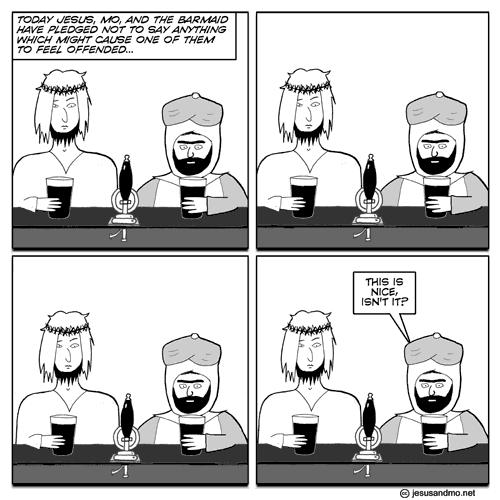
But... let's not get carried away.

Image result for jesus and mo cartoon

Genetic Basis For Behavior

Image may contain: text