Up@dawn 2.0

Friday, February 7, 2020

DETERMINISM & CRIMINAL RESPONSIBILITY


The American criminal justice system is based on the notion that individuals are responsible for their actions and can be punished when they choose to violate societal standards. Thus it is said to be rooted in the concept of “free will.” If all human actions and choices are caused by factors beyond the actor’s control, and is therefore morally excused, then that action or choice should not be legally punishable. This leads to the absurd conclusion that no actions or choices should be legally punishable.

Criminal liability follows from a determination that an actor engaged in criminal conduct by inquiring (1) did the defendant voluntarily engage in proscribed conduct (actus reus), and (2) if he did, was he aware of the circumstances that made his conduct criminal (mens rea)?   Actus reus and mens rea include the presumption that individuals are responsible agents capable of making choices and intending the natural consequence of their acts. “Voluntarily” implies that an individual exercised his free will in doing the act, or that he could have done otherwise.

It is helpful in discussing the relationship between criminal law and behavioral genetics to distinguish between the broad concept of free will (“theoretical free will”) and “legal free will.”   Theoretical free includes philosophical, metaphysical, psychiatric, and biological perspectives on the subject. Legal free will is simply based on the presumption that individuals actively choose to engage in criminal conduct.  Legal free will theory contends that human behavior in a given situation is the result of individual choices made by autonomous actors.  It assumes that individuals have the inherent ability to choose or choose not to act in a certain way.  Human choice is fundamental to the operation of the system of laws, a necessary presumption to foster better social relationships.  This is based on the belief that social systems are strengthened by holding people responsible for their conduct.   Legal free will is value preference; it exists along with causal agents.

Our criminal justice system is an “excusing system.”  In addition to the requirement of a certain mental state (mens rea) such an intent, purpose, knowledge, recklessness, or negligence, our system recognizes certain excuses from criminal liability. The generally recognized excuses are mistake, accident, provocation, insanity, and duress.   An excuse says that even though I did the act, I am not culpable because some disability in my freedom to choose the right thing makes it inappropriate to punish me.

Excuses focus on the actor and his subjective mental state.   Excuses are different from justifications used to avoid criminal responsibility, such as self-defense.   Justifications entitle others to act in the same way under similar circumstances.   Excuses do not make an act any less wrongful, and therefore do not create an entitlement to act in a certain way.   The question raised by determinism is whether predispositions to engage in behavior that society has declared criminal resulting from genetic or other biological factors should serve as an excuse to criminal liability.

Because full determinism and application of the causal theory of excuse lead to the absurd result of no responsibility, the concept of “degree determinism” is used to allow acceptance of determinism as well as criminal responsibility.  Degree determinism holds that all human conduct is not fully caused; that varying degrees of determinism and free will exist in all actions on a continuum from freedom to causation.  Thus the question becomes at what point on the continuum does human behavior become so determined that the actor lacks choice and thus his actions are not blameworthy?

The one biologically based defense recognized as a defense to criminal responsibility is insanity.   The defense is limited, however, to medical proof that a defendant suffered from a mental illness or defect.   Courts reject claims of mental illness based on a genetic predisposition, generally on the basis that the defendant can appreciate the wrongfulness of his act notwithstanding any genetic predisposition.

Defendants have offered a variety of defenses based on biological deficiencies, including genetic deficiency, automatism, amnesia, Post-traumatic Stress Syndrome, premenstrual syndrome, along with severe environmental deprivation and battered woman’s syndrome, and recently “affluenza,” the defense that a teenage defendant was unable to understand the consequences of his actions because of his financial privilege. Defendants have argued that their acts were not voluntary, in that because of a genetic predisposition to addiction, violence, impulsivity, or other biological trait they did not exercise free will, but were compelled to act. These attempts have been generally unsuccessful.  Courts seek a causal link between an asserted behavioral predisposition and the criminal act, and they are unwilling to accept statistical data when considering whether that link exists for a specific act.  

Defendants generally have used behavioral predisposition arguments in the sentencing phase rather than in the guilt phase of a trial, arguing that their genetic makeup or socio-economic background is a mitigating factor in their culpability.  This is a double-edged sword, however, for courts can use the behavioral disposition as an aggravating, as opposed to mitigating, factor in sentencing.


Wednesday, February 5, 2020

Free the dominoes!

Another Go At Free Will

Because I find this particular topic so very interesting, I can't resist trying to restate--improve, hopefully--my argument against free will. I'm encouraged to do this as I continue to read Flanagan's The Really Hard Problem as a companion to our text on neuroexistentialism.

Taking a cue from Flanagan, I realize just how important it is in this conversation to be as clear as possible about what we mean by free will. So, when I say I'm against free will I mean that I'm against what Flanagan presents as the Cartesian kind of free will: "[T]he will is so free in its nature, that it can never be constrained" (32). It is this kind of free will that operates as an unmoved mover, capable of causing things to happen while also being not caused by any thing else.

Perhaps, for those of us who are the kind of naturalists/physicalists discussed so far, we can agree that the above notion of free will is incompatible with the scientifically revealed picture of a world in which "everything that happens . . . happens because antecedent things happened, and so on"(31). Human beings, taken as totally natural, are subject to the same principle of causation that determines the unfolding of events in the world. We, being part of and inseparable from the natural world, are caught up in this causal nexus (a very fun expression to both say and write, by the way).

This is why I borrowed and doggedly continued using the analogy of the dominoes, which I'll keep using--likely to the breaking point.

To retort that the unfolding of events in the world is exponentially more complex--as in, there are a ton more forces at work--would be like saying 230,510 + 115,782 doesn't follow the same principle of addition as 2 + 3 because the former involves much greater numbers. Whether the numbers are big or small, you solve both problems by adding them up. Likewise, however numerous the forces or events in the world might be, they still would operate according to the principle of causation and yield determined results.

I don't find the idea of having the potential to choose any more persuasive. Back to the dominoes. A domino as an object in space has the potential (in the sense of possibility, I guess) to do a number of things: fall flatly forward, rotate clockwise or counterclockwise, flip end over end. However, when particular forces act upon a domino it isn't going to do any one of these things, it's actually going to do only one thing and--with certain forces operative--it must do that one thing.

Thinking that this isn't applicable to human beings because we are sentient and not just dominoes takes us right back to the top of this post: we'd be overstating the awareness of our selves--especially of what's happening in our brains--as being some levitating seat raised above the causal fray and from which we can issue finally self-determined commands. Of course, our experience and intuition makes this a tempting mistake. Flanagan says, "When I deliberate and choose among the options before me, I am in touch with the relevant processes, the processes of deliberation and choice. I am not in touch with--indeed I am normally clueless about--what causes me to deliberate and weigh my options as I do. So I make a misstep and think deliberation is self-cause. It seems that way, after all" (35).

So, here's an alternative from Flanagan. He suggests that we ditch the more Cartesian free will in favor of a freedom that attends more, a la Aristotle, to the distinction between voluntary and involuntary action. The former involves coercion and ignorance; the latter, personal reasoning and desire. So, the degree to which what you are doing is what you intend to be doing and the reasoning and/or desire to do it is your own  is the degree to which you are "free" (I mean "own" NOT in the sense of being un-caused but in the sense of being consistent with your own subjective experiences and mental states, e.g. I eat a veggie sandwich because I am indeed hungry and would agree to eat something good for my cholesterol levels--not because a renegade fascist vegan makes me when I'm really not hungry or would prefer the juicy hamburger in my fridge).

I think this takes me back to what I said in class about awareness and, let's say, the state of being truly informed. Knowing that I'm a domino and knowing, in so far as is possible, what forces are acting upon me, and making choices in light of this makes it possible--in my estimation--for me to feel free enough.


Free will

"My first act of free will shall be to believe in free will."
LISTEN


Do you have free will? Or are you simply a product of your culture? How much responsibility should you take for your actions? Are your neural pathways fixed early on by a mixture of nature and nurture, or is the possibility of comprehensive, intentional psychological change always open? What role does your brain play in the construction of free will, and how much scientific evidence is there for the existence of it?
In this talk, Julian Baggini will explore free will from every angle, blending neuroscience, philosophy, sociology and cognitive science. Contemporary thinking tells us that free will is an illusion, but Baggini challenges this position, providing instead a new, more positive understanding of our sense of personal freedom: a freedom worth having.
Julian Baggini is a British philosopher and author of several books including ‘The Ego Trick’, ‘The Pig that Wants to be Eaten’, ‘Freedom Regained’, and most recently ‘A Short History of Truth.’ He runs the popular blog: Microphilosophy, and writes regularly for national newspapers and magazines such as the Guardian, the Financial Times, the TLS and Prospect. He is a regular guest on BBC Radio 4, and tweets at @microphilosophy.
==
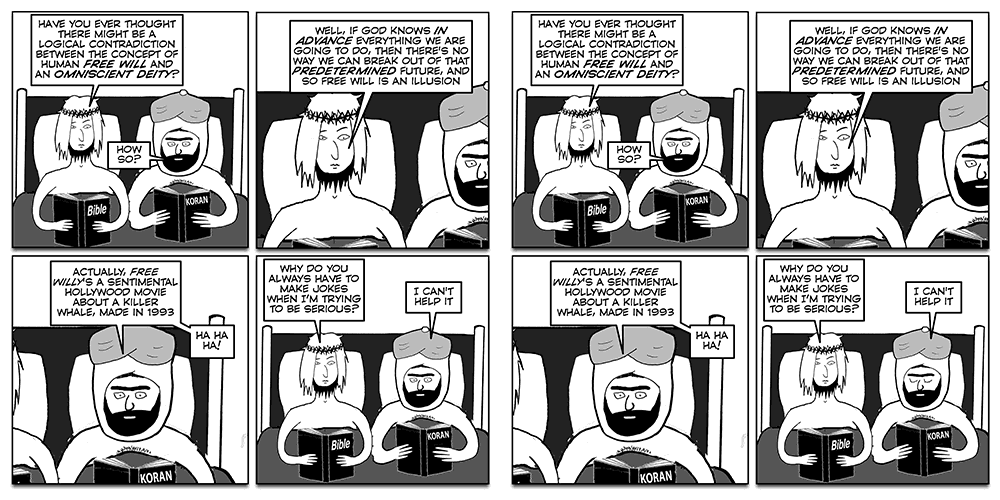
Christians (and others) often insist that free will is God's gift. But is the Judeo-Christian God even compatible with human free will?

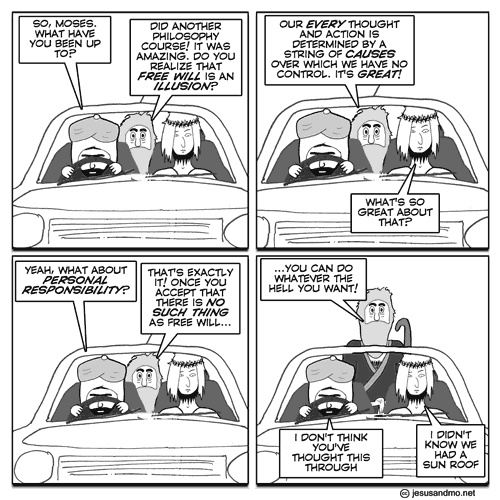
If we don't have free will, does that really make us free of personal responsibility and free to do whatever the hell we want? "Moses" thinks so, but hasn't thought it entirely through.

More J&M
==
Man can do what he wills but he cannot will what he wills.” 
― Arthur Schopenhauer, Essays and Aphorisms


Daniel C. Dennett
“But recently I have learned from discussions with a variety of scientists and other non-philosophers (e.g., the scientists participating with me in the Sean Carroll workshop on the future of naturalism) that they lean the other way: free will, in their view, is obviously incompatible with naturalism, with determinism, and very likely incoherent against any background, so they cheerfully insist that of course they don't have free will, couldn’t have free will, but so what? It has nothing to do with morality or the meaning of life. Their advice to me at the symposium was simple: recast my pressing question as whether naturalism (materialism, determinism, science...) has any implications for what we may call moral competence. For instance, does neuroscience show that we cannot be responsible for our choices, cannot justifiably be praised or blamed, rewarded or punished? Abandon the term 'free will' to the libertarians and other incompatibilists, who can pursue their fantasies untroubled. Note that this is not a dismissal of the important issues; it’s a proposal about which camp gets to use, and define, the term. I am beginning to appreciate the benefits of discarding the term 'free will' altogether, but that course too involves a lot of heavy lifting, if one is to avoid being misunderstood.”
― Daniel C. Dennett, Consciousness Explained
Sam Harris
“Losing a belief in free will has not made me fatalistic—in fact, it has increased my feelings of freedom. My hopes, fears, and neuroses seem less personal and indelible. There is no telling how much I might change in the future. Just as one wouldn’t draw a lasting conclusion about oneself on the basis of a brief experience of indigestion, one needn’t do so on the basis of how one has thought or behaved for vast stretches of time in the past. A creative change of inputs to the system—learning new skills, forming new relationships, adopting new habits of attention—may radically transform one’s life.”
― Sam Harris, Free Will
Fyodor Dostoyevsky
“Know, then, that now, precisely now, these people are more certain than ever before that they are completely free, and at the same time they themselves have brought us their freedom and obediently laid it at our feet. It is our doing, but is it what you wanted? This sort of freedom?'
Again I don't understand', Alyosha interrupted, 'Is he being ironic? Is he laughing?'
Not in the least. He precisely lays it to his and his colleagues' credit that they have finally overcome freedom, and have done so in order to make people happy.”
― Fyodor Dostoevsky, The Brothers Karamazov
More determinism quote
==

Freedom Evolves

2071Can there be freedom and free will in a deterministic world? Renowned philosopher Daniel Dennett emphatically answers "yes!" Using an array of provocative formulations, Dennett sets out to show how we alone among the animals have evolved minds that give us free will and morality.... drawing upon evolutionary biology, cognitive neuroscience, economics, and philosophy [he argues that] far from being an enemy of traditional explorations of freedom, morality, and meaning, the evolutionary perspective can be an indispensable ally. Dennett seeks to place ethics on the foundation it deserves: a realistic, naturalistic, potentially unified vision of our place in nature. g'r

From Bacteria to Bach and Back: The Evolution of Minds

35167699How did we come to have minds? For centuries, poets, philosophers, psychologists, and physicists have wondered how the human mind developed its unrivaled abilities. Disciples of Darwin have explained how natural selection produced plants, but what about the human mind?
In From Bacteria to Bach and Back, Daniel C. Dennett builds on recent discoveries from biology and computer science to show, step by step, how a comprehending mind could in fact have arisen from a mindless process of natural selection. A crucial shift occurred when humans developed the ability to share memes, or ways of doing things not based in genetic instinct. Competition among memes produced thinking tools powerful enough that our minds don’t just perceive and react, they create and comprehend. g'r
"According to my theories, consciousness is not a nonphysical phenomenon and free will is not a phenomenon isolated from causation..." 
.

Tuesday, February 4, 2020

Anti-natalism

So glad my parents were pro-natalists.


THE CASE FOR NOT BEING BORN

The anti-natalist philosopher David Benatar argues that it would be better if no one had children ever again.

David Benatar may be the world’s most pessimistic philosopher. An “anti-natalist,” he believes that life is so bad, so painful, that human beings should stop having children for reasons of compassion. “While good people go to great lengths to spare their children from suffering, few of them seem to notice that the one (and only) guaranteed way to prevent all the suffering of their children is not to bring those children into existence in the first place,” he writes, in a 2006 book called “Better Never to Have Been: The Harm of Coming Into Existence.” In Benatar’s view, reproducing is intrinsically cruel and irresponsible—not just because a horrible fate can befall anyone, but because life itself is “permeated by badness.” In part for this reason, he thinks that the world would be a better place if sentient life disappeared altogether.


For a work of academic philosophy, “Better Never to Have Been” has found an unusually wide audience. It has 3.9 stars on GoodReads, where one reviewer calls it “required reading for folks who believe that procreation is justified.” A few years ago, Nic Pizzolatto, the screenwriter behind “True Detective,” read the book and made Rust Cohle, Matthew McConaughey’s character, a nihilistic anti-natalist. (“I think human consciousness is a tragic misstep in evolution,” Cohle says.) When Pizzolatto mentioned the book to the press, Benatar, who sees his own views as more thoughtful and humane than Cohle’s, emerged from an otherwise reclusive life to clarify them in interviews. Now he has published “The Human Predicament: A Candid Guide to Life’s Biggest Questions,” a refinement, expansion, and contextualization of his anti-natalist thinking. The book begins with an epigraph from T. S. Eliot’s “Four Quartets”—“Humankind cannot bear very much reality”—and promises to provide “grim” answers to questions such as “Do our lives have meaning?,” and “Would it be better if we could live forever?”

Benatar was born in South Africa in 1966. He is the head of the philosophy department at the University of Cape Town, where he also directs the university’s Bioethics Centre, which was founded by his father, Solomon Benatar, a global-health expert. (Benatar dedicated “Better Never to Have Been” “to my parents, even though they brought me into existence.”) Beyond these bare facts, little information about him is available online. There are no pictures of Benatar on the Internet; YouTube videos of his lectures consist only of PowerPoint slides. One video, titled “What Does David Benatar Look Like?,” zooms in on a grainy photograph taken from the back of a lecture hall until an arrow labelled “David Benatar” appears, indicating the abstract, pixellated head of a man in a baseball cap... (continues)

Sam Harris on the Joe Rogan Experience

This is a link to a podcast that I very much enjoyed listening to. I will warn that there is some foul language, and they are speaking with a candor not usually found in professional or academic environments.

https://youtu.be/ZA106wrMUe4