PHIL 3310. Exploring the philosophical, ethical, spiritual, existential, social, and personal implications of a godless universe, and supporting their study at Middle Tennessee State University & beyond.
...“I’m not religious, but I am spiritual.” I told the congregation what I thought people meant by this. They mean that they reject the creeds and institutions of traditional religions, organised or not. They can’t accept that any religion has a claim to divine truth when history suggests that every religion is the product of the particular time and place in which it emerged. Religions are too obviously human institutions to own universal truth, and sacred texts too obviously the product of the human hand to claim divine authorship.
Nor do the best-known teachings of the main religions make sense to them. They don’t believe in the stories of ancient miracles, of angels dictating God’s word, of a saviour rising from the dead. Even more unbelievable is the need to perform certain rituals in order to attain salvation, or at least to have a relationship with God.
But rejecting all this does not mean they are willing to embrace the full-blown naturalism of atheism. They cannot believe there is nothing more than the physical realm. They believe that there is more to life than the material, and that something they give the label “spiritual”.
All this I can see. But I think the division between the religious and the spiritual that it suggests is profoundly misleading. Consider the category of the “spiritual”. It is often used to cover anything that cannot be understood in purely physical terms, like love, beauty and morality. These things comprise the “something more” than the physical that those who call themselves spiritual often seek...
Sean Carroll is one wise theoretical physicist and "poetic naturalist." His Ten Commandments Considerations, resisting the unfortunate human impulse to tell one another what to do, deferring instead to one another's mental freedom:
Life Isn’t Forever.
Desire Is Built Into Life.
What Matters Is What Matters To People.
We Can Always Do Better.
It Pays to Listen.
There Is No Natural Way to Be.
It Takes All Kinds.
The Universe Is in Our Hands.
We Can Do Better Than Happiness.
Reality Guides Us.
Naturalists accept that life is going to come to an end — this life is not a dress rehearsal for something greater, it’s the only performance we get to give. The average person can expect a lifespan of about three billion heartbeats. That’s a goodly number, but far from limitless. We should make the most of each of our heartbeats.
The finitude of life doesn’t imply that it’s meaningless, any more than obeying the laws of physics implies that we can’t find purpose and joy within the natural world. The absence of a God to tell us why we’re here and hand down rules about what is and is not okay doesn’t leave us adrift — it puts the responsibility for constructing meaningful lives back where it always was, in our own hands.
In the beginning, Ken Ham made the Creation Museum in northern Kentucky. And he saw that it was good at spreading his belief that the Bible is a book of history, the universe is only 6,000 years old, and evolution is wrong and is leading to our moral downfall.
And Mr. Ham said, let us build a gargantuan Noah’s ark only 45 minutes away to draw millions more visitors. And let it be constructed by Amish woodworkers, and financed with donations, junk bonds and tax rebates from the state of Kentucky. And let it hold an animatronic Noah and lifelike models of some of the creatures that came on board two-by-two, such as bears, short-necked giraffes — and juvenile Tyrannosaurus rexes...
“We’re going to raise a generation of kids who are scientifically illiterate,” said Mr. Nye, who debated Mr. Ham at the Creation Museum in 2014, a matchup watched online by millions...
“He calls on Christians to participate in a culture war,” Mr. Trollinger said, of Mr. Ham. “He says, if you’re really going to be a Christian, you’re in this war against the atheistic, humanistic enemy.” nyt
I came across this article and found it quite interesting. It's neat to see de Botton's ideas illustrated. Personally I quite enjoy the style, and would love to see this idea made a reality! Also relevant is de Botton's plans to build his own atheist temple. I've pasted the article below:
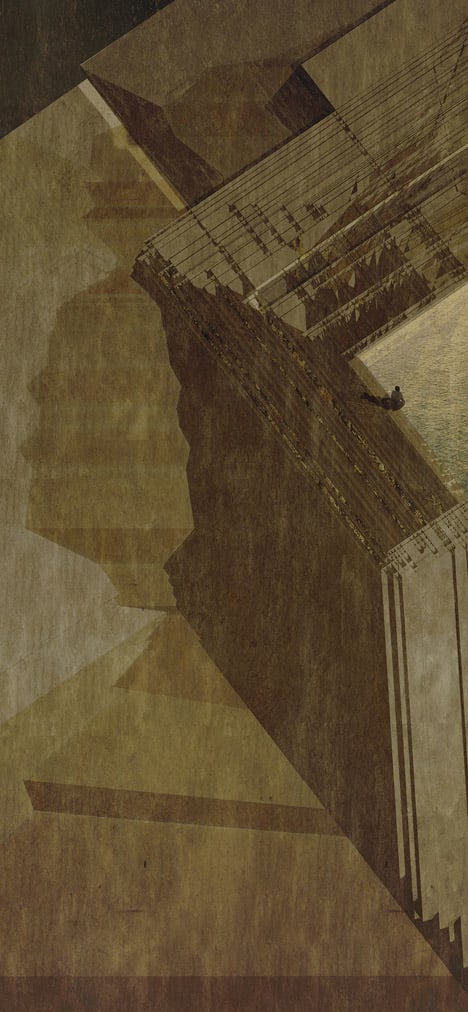
Bartlett School of Architecturestudent Kacper Chmielewski has developed a new style of architecture
specifically for atheists, including a shrine to the oak tree (+
slideshow).
Oak landscape
Building on the philosophies of Alain de Botton, who in 2012 advocated Atheist temples for London, Chmielewski
proposes a series of structures intended to inspire awe without any
references to religion. He calls the project Atheistic Architecture. Oak landscape
The designer claims that by 2040, less than one per cent of Britain's
population will be a member of the Anglican Church. But there are still
55 churches in the City of London, which he believes have become wasted
spaces – so he wants to replace them. Oak landscape
"The institution of church has become a monument to the past, both in
terms of the community and its architecture," Chmielewski explained.
"These beautiful temples are decreasingly used for spiritual reasons
and are more often being converted into commercial coffee shops – a
saddening waste of their potential."
Oak landscape
"In Religion for Atheists, Alain de Botton writes about the need for a
new typology for atheistic temples," the designer told Dezeen. "He
perfectly describes a sense of nostalgia that I feel for religious
architecture."
"This project is a response accommodating both the discourse between
nostalgia for ecclesiastical beauty and the rejection of fallen
religious doctrine." St Mary-Le-Bow transformation
Chmielewski's proposal centres around St Mary-Le-Bow, the historic
church on Cheapside designed by Christopher Wren to replace a
predecessor destroyed in the Great Fire of 1666.
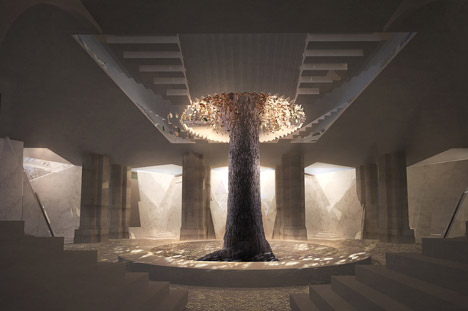
He proposes converting the building into what he describes as "an
ever-evolving open cathedral" celebrating the life cycle of the oak
tree. The aim is to create a building that incites awe through an
awareness of the scale of nature and the universe. St Mary-Le-Bow transformation
"In today's world, society deprives atheists of places where they can
submerse themselves in a moment of solitude, feel a part of something
greater, or perhaps connect with nature and the universe," explained
Chmielewski. Celebration Hall
The structure would feature a facade made up of 39,999 sheets
of marble with gold trims – referencing the many generations of humanity
– as well as a roof terrace for quiet contemplation, and a celebration
hall for events.
It would also house the headquarters and library for the British
Humanist Association, a non-profit organisation that works on behalf of
non-religious people. St Mary-Le-Bow window detail
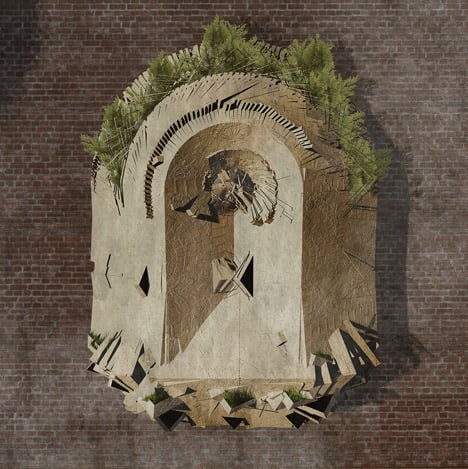
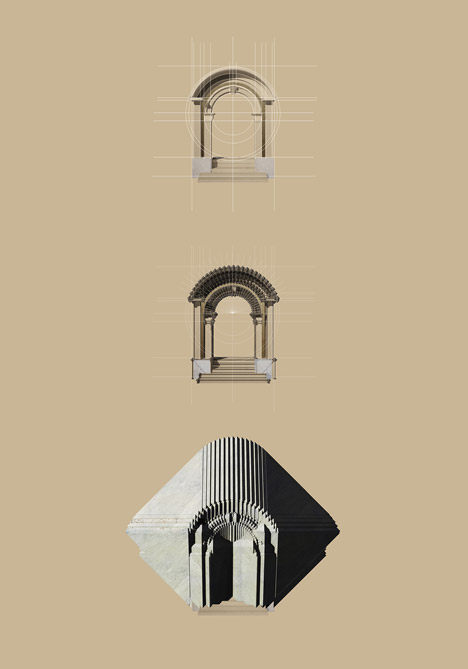
Chmielewski's designs, laid out in a series of intricate drawings,
intentionally draw on elements of Cubist architecture. Imagined on a
city scale, he describes the new typology as "waging war with the
previous system of values". St Mary-Le-Bow gate transformation
"Atheistic architecture opposes religious hierarchy between a deity
and its creations. It replaces it with scientific detailing, mimicking
nature's incredible spread in infinite detail," he added. British Humanist Association Library
Atheistic Architecture was completed as part of the master programme
at the Bartlett School of Architecture in London. Chmielewski was part
of Unit 12, which is led by tutors Jonathan Hill, Elizabeth Dow, Matthew
Butcher, and which this year focussed on monuments and ruins within the
city.
With an increasing number of Americans leaving religion behind, theUniversity of Miami received a donation in late April from a wealthy atheist to endow what it says is the nation’s first academic chair “for the study of atheism, humanism and secular ethics.”
The chair has been established after years of discussion with a $2.2 million donation from Louis J. Appignani, a retired businessman and former president and chairman of the modeling school Barbizon International, who has given grants to many humanist and secular causes — though this is his largest so far. The university, which has not yet publicly announced the new chair, will appoint a committee of faculty members to conduct a search for a scholar to fill the position.
“I’m trying to eliminate discrimination against atheists,” said Mr. Appignani, who is 83 and lives in Florida. “So this is a step in that direction, to make atheism legitimate.”
Religion departments and professors of religious studies are a standard feature at most colleges and universities, many originally founded by ministers and churches. The study of atheism and secularism is only now starting to emerge as an accepted academic field, scholars say, with its own journal, conferences, course offerings and, now, an endowed chair.
“I think it’s a very bold step of the University of Miami, and I hope there will be others,” said Richard Dawkins, an evolutionary biologist and atheist luminary who is the author of “The God Delusion.”
“It’s enormously important to shake off the shackles of religion from the study of morality,” Mr. Dawkins said in a telephone interview from his home in Britain.
The percentage of Americans who claim no religious affiliation has risen rapidly in a short time, to 23 percent of the population in 2014, up from 16 percent in 2007, according to a report by the Pew Research Center. Younger people are even less religious, with 35 percent of millennials saying they identify as atheist, agnostic or with no religion in particular.
Secular Americans are beginning to organize themselves politically. Next month, nonbelievers are headed to Washington to lobby Congress and hold a “Reason Rally” at the Lincoln Memorial to showcase their numbers and promote the separation of church and state.
With atheists still often stigmatized and disparaged in this country, it took some persuading for the University of Miami to agree to create a chair with the word “atheism” in the title, according to Harvey Siegel, a professor of philosophy who has helped to broker the arrangement. He said that more than 15 years ago, when he was chairman of the philosophy department, he and Mr. Appignani first began discussing the idea for a chair to study atheism and secularism.
“There was great reluctance on the part of the university to have an endowed chair with the word ‘atheism’ in the name, and that was a deal-breaker for Lou,” Mr. Siegel said. “He wasn’t going to do it unless it had the word atheism in it.”
The university had reason to be cautious, Thomas J. LeBlanc, executive vice president and provost, said in an interview.
“We didn’t want anyone to misunderstand and think that this was to be an advocacy position for someone who is an atheist,” he said. “Our religion department isn’t taking an advocacy position when it teaches about Catholicism or Islam. Similarly, we’re not taking an advocacy position when we teach about atheism or secular ethics.”
Asked whether he anticipated any backlash, Mr. LeBlanc said: “This is an area where people can get overly excited if they don’t actually look carefully at what’s happening. The idea that there are nondeity approaches to explaining our surroundings is not controversial in the academy.”
Mr. Appignani said he rejected a last-minute proposal from a dean to call it a chair in “philosophical naturalism.” Instead, he and the university leaders worked out the title, broadening the scope by including humanism and secular ethics.
Mr. Appignani was raised a Roman Catholic in the Bronx by Italian immigrant parents. His father was a clothing presser in the garment district. He attended Catholic schools and said he became a nonbeliever at the City College of New York when he discovered the work of Bertrand Russell, the British philosopher and Nobel Prize winner.
With the money he made from the Barbizon school, he said, he created the foundation that has given grants to groups like the American Humanist Association and the Secular Coalition for America, and the Appignani Humanist Legal Center.
Over the years, Mr. Appignani has sponsored two public lectures by Mr. Dawkins at the University of Miami. The discussions about a chair gained momentum last year with the arrival of a new university president, Julio Frenk, Mr. Siegel said.
Dr. Frenk announced that he intended to recruit new talent by creating 100 new chairs in time for the university’s centennial anniversary, in 2025, said Margot S. Winick, an assistant vice president at the university. The chair in atheism is the fifth he has added so far, she said.
Pitzer College, a liberal arts school in Southern California with about 1,000 students, became the first to begin a program and major in secular studies five years ago. Phil Zuckerman, a sociologist of religion who founded the program, said it now offered four courses on secularism of its own and many others by the six professors associated with the department. Only two students have chosen to major in secular studies, he said, but the courses are popular. For its “Secularism and Skepticism” class last year, he turned away 25 students, more than the 22 he was able to admit.
“There is a real need for secular studies,” Mr. Zuckerman said. “As rates of irreligion continue to rise, not only here in the U.S.A. but all over the world, we need to understand secular people, secular culture, and secularism as a political and ideological force.”